•
1772
Yoshiwara Pleasure Quarter
Edo, Japan
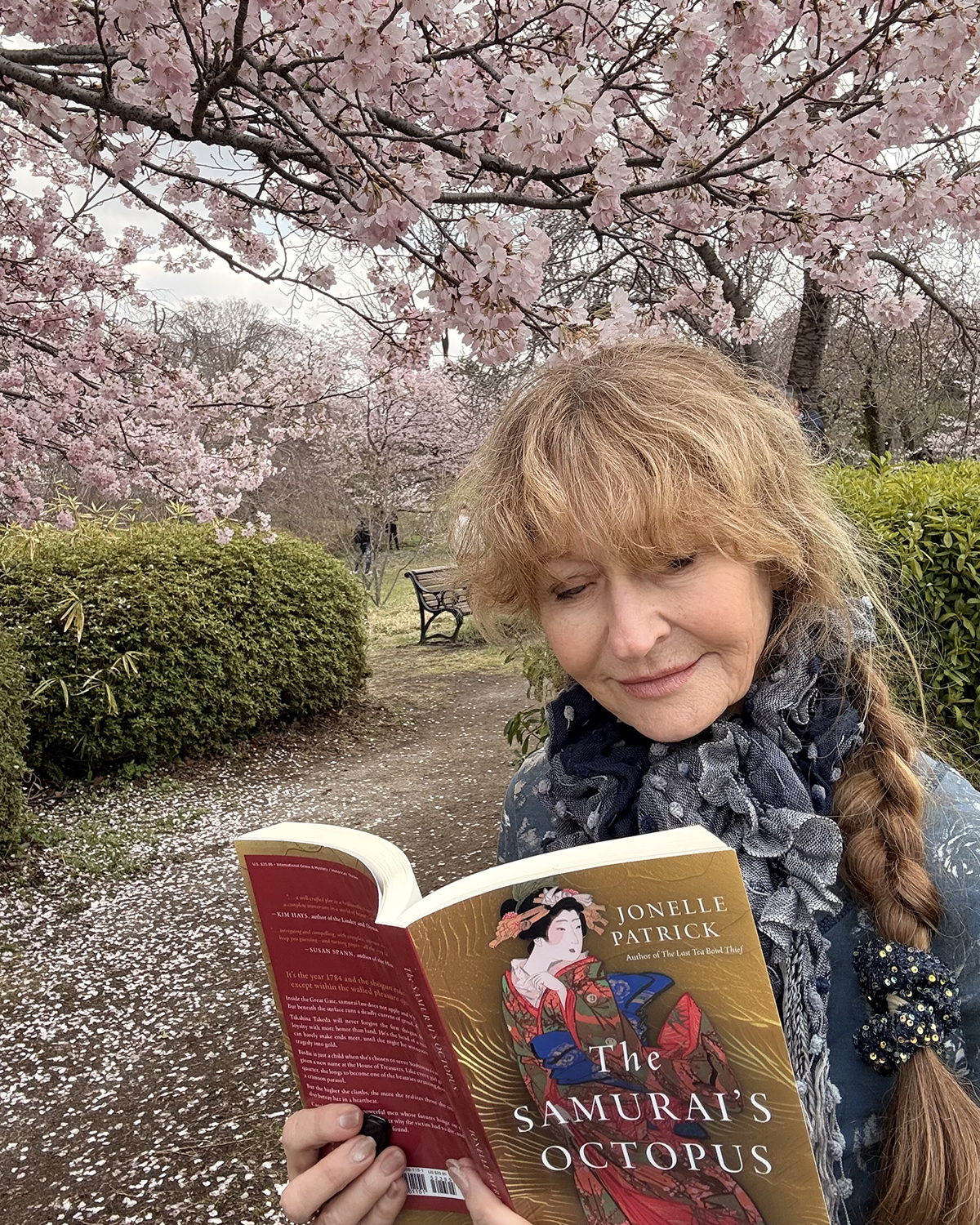
It’s the kind of balmy spring evening that inspires even mediocre poets to greatness, but nobody is gazing at the cherry blossoms. The pink clouds overhead can’t compete with the pageantry unfolding on Teahouse Street. Procession after procession of beautiful women in costly robes are parading down Yoshiwara’s main boulevard as the sky deepens to dusk, and wealthy men are about to outspend each other with legendary foolishness until dawn.
But for every queen of the night, there are a hundred beauties eager to take her place. And for every lord who can afford the attentions of a first-rank courtesan, there are a thousand solitary men who turn their backs on the glittering display and glance around before joining other furtive figures slinking down the shabby street just inside the Great Gate.
•
Head down, Takahisa Takeda walks with purpose, aiming his steps toward a wooden building with a tattered lantern hanging out front. He gives a woman’s name and a coin to the crone who makes sure men aren’t interrupted by the next customer before they’re finished.
“She’s busy right now.” The woman stows the money in her sash. “You can wait over there.” She jerks her chin toward the bench by the door, where two men are already ignoring each other.
He perches at the far end. Studying the dirt between his feet, he recalls the last time he waited outside this door. His fantasies never include the stink of moat water, but now that he’s here, the foul odor both repels him and sharpens his desire.
A man emerges, still adjusting his sash about his hips.
When it’s his turn, he mounts the steep stairs and slips without invitation into the woman’s room. She greets him with a sum. He agrees, even before his eyes adjust to the dim light from the single smoking candle. She doesn’t smile. She never smiles. Her sash is tied loosely in front—why bother with a proper knot? Lowering herself onto the pallet in the corner, her collar gapes, the coarse skin of her neck at odds with the girlish pattern of her kimono. As he sheds his jacket and tobacco pouch, she glances at him and turns away, but not before he sees the look on her face.
His desire shrinks, recoiling from the sting of her distaste. Does he not give her good money to conceal it? How dare she suggest that a woman like her would spurn a man like him if he weren’t paying! He grabs a fistful of her robe and yanks her upright. The urge to possess her returns. Now that he has her attention, he means to get his money’s worth.
Afterward, he counts out the coins and leaves them in a dish by the door. He owes her no such courtesy, but putting them directly in her hand would be unseemly for a samurai. As she picks herself up from the pallet, he slides her door shut behind him, averting his eyes from the next fool already rising from the bench outside.
The guilty anticipation that sped his steps over the mountains on his annual timber-selling trek to Edo is now spent, and the sooner he leaves her behind, the better. Regrets chase him like a flock of crows as he hurries toward the main boulevard. He has spent money he can’t spare. Done things he hadn’t intended. That grubby amulet dangling between her breasts, smelling more of sweat than sandalwood. The musk of unwashed hair at the nape of her neck. He shudders. What compels him to disgrace himself with a woman like that? Disgusting. Revolt—
“Sorry!” they both say at once.
The big oaf squints at him.
“Takeda–san?”
Takeda stares, can’t quite place him. Boldly striped silk wraps his considerable girth, one plump hand fingering a fox-shaped netsuke bead attached to his tobacco pouch. Surely this can’t be—
“I thought it was you” the timber broker says with a smirk.
How dare that son-of-a-merchant stand there, unapologetically flaunting the fat percentage he skims from selling lumber for samurai families like the Takedas! Is it not illegal for an abacus-clicker to dress more lavishly than his betters?
Takeda manages a grudging bow. Merchants like this fat toad are supposed to rank beneath the farmers who feed the nation and the artisans who craft the tools to make it run, and farthest of all below the samurai who bought nearly two hundred years of peace with their blood. Merchants grow nothing, make nothing, defend nothing, but somehow, the lowest of the low have become the richest of the rich.
“What brings you to Yoshiwara today, Takeda-san?” The trader’s sly smile adds, don’t pretend I didn’t catch you on the most disreputable street in the pleasure quarter, ticking off your sins like a string of prayer beads.
“Why does any man come to the pleasure quarter?” As if he’s not here to indulge his own wiggly little perversions.
“I’d never have guessed a samurai of such distinguished lineage as yourself would be interested in the modest entertainments of Yoshiwara.” And knowing how little you make off the Takeda timber, I’m surprised you can afford them. “I’d ask you to join me,” the merchant murmurs with false regret, “but I’m afraid I have some urgent business to conduct this evening. Perhaps some other time?”
When crows swim and fish fly. At least he’s saved the trouble of refusing. The pittance this jumped-up swine got for the Takeda timber last year was barely enough to keep them in rice and retainers. He can’t afford to reciprocate.
“Speaking of business…” The middleman’s eye strays to a teahouse across the street. “I’m afraid I must excuse myself, or I’ll be late.” Sketching a bow, he darts in front of an approaching oiran procession in time to hail a dandy just arriving at the teahouse, ushering him inside with greedy glee.
Takeda had assumed their timber agent was years older than himself, but now he’s not so sure. How unpleasant to think that someone observing the man in that gaudy get-up talking with a samurai in the stiff “city” kimono he inherited from his father might think him the elder of the two. This morning he’d spied a few more threads of white in his topknot before it was oiled, but inside he still feels like a young man: wiry and tough, a man easy to underestimate, who then bests you in a fight. He’d had plenty of practice at that in his boyhood every time his brothers danced around him, pulling their eyes up on one side and down on the other, crying “Squinty! Squinty!” It wasn’t his fault that the pox had spared their smug little faces and branded his alone. He’d made them sorry.
The House of Peonies procession arrives, and he turns to watch, skipping over the lantern-bearer and child attendants to glance at the novices—silly, giggly girls, in their trailing butterfly sleeves—before studying the second-rank courtesans, who are pretending to be demure or haughty, but aren’t above casting a nod or a wink at the right man.
A sigh goes up all around as the crowd catches sight of the oiran they’ve been waiting for, dressed in robes that cost more than most of them make in a year. Slow and sinuous, she glides forward like a swan parting the sea of men pressing in from either side, flipping the weighted hem of her kimono with each swaying step to reveal a flash of scandalously red underrobe. Her oval face is powdered the pure white of a spring moon, her eyebrows charcoaled into graceful feathers. And her lips! Her lips are painted as red as the parasol bobbing above her, the pomade’s iridescent sheen whispering that she’s one of the few courtesans who can afford the tens of thousands of safflower petals that were crushed to make it.
What he wouldn’t give to be waiting for this one at a teahouse right now! He shifts his hungry gaze to the hem of her robe, and there, a crotch-tightening glimpse of bare foot. He adjusts his kimono, embarrassed by the unwelcome stirring. Turning to follow her receding parasol down the street, his attention is drawn instead to a column of smoke towering over the Great Gate.
Fire.
It’s burning somewhere far beyond Yoshiwara’s walls, but now that he sees the smoke, he can smell it too. And must have been doing so for some time, because the sky is a strange, pale orange. Could this be the same blaze that was making a vague smudge on the horizon this morning, the one he’d dismissed as being too distant to alter his plans?
He curses under his breath. The wind must have shifted, because now the plume of smoke is pointing in a different direction, and the fire is heading straight toward the inn where he left his servant and traveling pack.
Hastening to the line forming at the Great Gate, he retrieves his swords from the gatekeeper. Lesser men stream past, and his mood sours even more. Now that he knows what kind of lowlifes are wearing the most stylish kimonos, he no longer admires them.
Slapping his longsword into its scabbard, he sheaths the short one, striding past the merchants climbing into their palanquins. Lazy bastards. He deals a savage kick to a rock in his path. Nearly half his life is over, and what has he got to show for it? A wife who’d married him only for his position. Three useless daughters, but only one son who’d managed to survive his first year. And a village full of restless retainers, who must be fed whether they cut timber or not.
Why hadn’t the gods blessed his family with luck, instead of cursing them with honor? After their Tokugawa allies had become the rulers of all Japan, his ancestor had been awarded a fiefdom several days’ journey northwest of Edo. But while the shōgun’s longtime loyalists wallow in the kind of rich, flat bottomland that produces bumper crops of rice every year, minor supporters like the Takeda clan barely eke out a living on rough terrain that’s good for growing only one thing. Trees, trees, and more trees. Which cost a lot more to harvest, transport and sell than rice, and must be converted into rice to pay their retainers. And the rice merchants—curse their money-grubbing souls—take a cut coming and going.
Ashes drift past like black snow. A large flake lands, quivering, on his sleeve. He slaps it off, leaving a streak. The main road that angles toward the inn is just ahead, but he must battle upstream against the river of refugees flowing out of the city in the opposite direction. They’re shuffling along with terrified determination, lugging misshapen bundles of randomly packed possessions, children slung on their backs, sacks of rice, a wriggling piglet. Some are bundled in as many layers as they can wear, some are shivering in what they had on when the wall of flames arrived with such speed that all they could do was flee with their lives.
The roar of the fire is louder now, the sky a ripe persimmon. It feels more like evening than afternoon. He coughs, raises the crook of his elbow to cover his mouth, picks up his pace.
He should be getting close. And . . . yes, the inn is still standing, although it looks abandoned, curtains flapping, door standing open. His traveling pack is still in the cupboard where he left it, but there’s no sign of his servant. He must have fled when he saw the fire.
He hoists the bundle onto his shoulders with a grunt. If he’d known he’d have to carry it himself, he’d have packed lighter. Bent under its weight, he joins the fleeing townsfolk, batting at the swarming ashes as if they were mosquitos.
Another stream of refugees swells the river of humanity, from a neighborhood where plenty of the lazy so-and-sos can afford servants to save them the trouble of walking. Their lacquered palanquins now rock above those trudging on foot as they climb past the outskirts, the crowd’s misery casting more gloom than the pall of smoke.
But Takeda has little sympathy to spare for strangers. How is he going to sell the Takeda timber now? Judging from the three…no, four…streams of smoke rising along the horizon, the losses will be staggering. Destruction on such a grand scale will lead to reconstruction on a grand scale, but—
The old resentment rises inside him like a bitter tide. The city will need lots of lumber to rebuild, but he already knows who will be getting those contracts. Not the Takeda clan. The capital city is burning to the ground, and his family won’t make a single copper mon from it. He has tried everything to obtain an introduction to the officials who buy construction supplies on behalf of the shōgun, but you have to belong to the right family or be introduced by the right people to even get an audience. You have to have influence to get influence. You have to be rich to get richer. Lashing out with his walking stick, he punishes a stand of roadside bamboo for this injustice.
Stepping out of line, he clambers up a rocky outcrop to check the fire’s progress. Stops at the crest, aghast. Even though he’s been breathing smoke for hours, he’s unprepared for the spectacular and awful sight of the shōgun’s city in flames. Over a quarter of Edo has been reduced to a smoking black hole, and the fire is still widening in a voracious red ring. His eyes dart over a landscape made unfamiliar by destruction, searching for landmarks. There, between drifting curtains of smoke, Edo Castle sits untouched behind its stout stone ramparts and moat. But the barracks surrounding it are gone. The Nihonbashi bridge, gone. And where Zojōji Temple once stood, only the gate remains. He can’t see Yoshiwara at all behind the billowing clouds, but the neighborhood where his middleman did business is nothing but ashes. How will he find him now? Has he made this trip for nothing? If he goes home empty-handed—
Something falls from a bundle bobbing along on the back of a merchant’s minion on the road below. The package bounces into the weeds, but the factotum trudges on. Takeda waits, watching. Is no one coming back to claim it? When he’s sure, he scrambles down to search the tall grass. He’d never steal a persimmon from a farmer’s tree, but the ones on the ground are anybody’s lunch.
There it is. He brushes it off. Peeks inside the wrapper. A roll of fine kimono silk! Pleased at the windfall, he forgets his troubles for a moment and stuffs it into his pack. Turns to consider the oncoming horde. Perhaps he can salvage something from this trip after all. Where there’s one dropped treasure, there might be more. From above, it looked like the fire has crept dangerously close to the neighborhood where high officials live, but the wind is blowing against it at the moment, so it should be safe to get closer and see what he can find. Striking out against the flow, he keeps a sharp eye on the ground beneath the oncoming feet.
And it pays off. An hour later, he’s richer by a splendid tobacco pouch, a painted fan, and an assortment of fine tortoiseshell combs that dropped unnoticed from the hair of wealthy women as they fled.
He ignores his stinging eyes and scratchy throat as he makes his way through the outskirts, because as the tide of refugees thins, the pickings are getting richer. A lady’s jeweled hair ornament. A handkerchief knotted around three gold coins.
The two-story houses standing shoulder to shoulder along this street are wider, more finely crafted than the ones farther out. Waterfalls trickle unseen in walled gardens behind firmly locked gates. This is where the hatamoto live, those vassals who are despised and envied above all others by provincial samurai like the Takedas. Their great-great-grandfathers had been awarded positions of trust by the first Tokugawa shōgun, and their families continue to occupy every seat of influence, controlling everything from the price of rice to the timber for new barracks.
They’d all fled, of course. Takeda hasn’t seen another living soul for some time. Those who live in this neighborhood can afford to save their own skins at the first whiff of smoke, leaving behind all but their most precious possessions to be protected by their perennial good luck and the police who roam the streets, deterring looters. This close to the fire, though, patrolmen are few and far between. He coughs, eyes the sky. A few more blocks, then he’ll turn back.
Over the distant crackle of the flames, he hears a shout. His head snaps up. Nobody ahead. One block over?
A woman shrieks. He peers down a gap between two garden walls, but it’s nearly dark now, hard to see anything in the flickering light of the advancing flames. The woman’s cries grow louder and more desperate. He curses. Poor or not, he’s still a samurai, and wears two swords; he can’t ignore the obligation that goes with them. Sidling down the narrow cut between the two houses, he loosens his long sword in its scabbard, eyes fixed on the gap at the end. A horse sidesteps past, a man leaps off.
He pauses, flattening himself against the wall. Only samurai are allowed to ride. If the man on horseback is police, he might not have to get mixed up in this after all. More shouting, then some ungentlemanly scuffling as two men grapple past the end of the alley, kicking up a cloud of dust. Does the patrolman need help? Should he show himself? He hesitates, remembering the valuables in his pack. Valuables that weren’t his an hour ago.
The unmistakable shring of a weapon being drawn. The woman shouts a warning, and his hand tightens on the hilt of his sword, but he hears no second blade leave its scabbard. More grunts, then a building in the distance collapses so loudly, he almost misses the “Hya!” of a rider urging the horse to go, go, go.
Silence, except for the roar of the fire.
He creeps to the end of the alley and pokes his head out. The galloping horse is careening away at full tilt, nearly at the end of the street now, a man and a woman clinging to its back. Her partly-unbound hair streams behind as they disappear around the corner.
It’s not until he turns to retrace his steps that he sees the body lying face down in the road. He runs to the man’s side, shocked to find it dressed in the wide-shouldered vest and matching pleated trouser-skirt of a Tokugawa retainer.
The man who rode away on the horse is not the man who arrived on it. Worse, the dead man is no policeman, he’s a man of rank.
Takeda rolls him over, but he’s past help, and his eyes are drawn to something made of gold lacquer lying in the bloody dirt. It’s an inrō, the kind of small, four-tiered case men use to carry necessities while wearing a kimono. Avoiding the parts that are sticky with blood, he picks up the box with two fingers, then catches it with his other hand as it begins to slide apart. The cord holding the sections together is broken. He casts about, looking for the large netsukebead that should have kept it from slipping through the wearer’s sash. It must be nearby. There, rolled off to the side. An intricately carved octopus, heavy enough to be ivory.
He glances back at the body, resisting an impulse to tidy the skewed topknot and pull down the rucked-up sleeve. He can’t risk getting blood on his “good” kimono; he doesn’t have another. Should he retrieve the dead man’s swords, though? As a samurai himself, he knows how the man’s family would treasure such heirlooms. He crouches to pull away the uniform vest to check the family crest on his kimono.
There isn’t one. That’s odd. He glances at the man’s face.
And recoils in horror. Scrambling to his feet, he backs away. He’d better get out of here. Now.
Only demons and foreigners have eyes like the ones staring lifelessly up at the smoke-roiled sky. The wrongness of someone who doesn’t belong here dressed like someone who does sets off all kinds of alarms. Even though the victim is less than Japanese, the death of a man in Tokugawa uniform will invite the kind of attention he can’t afford. Whoever finds the body can deal with the swords, if the fire doesn’t get here first.
But what about the inrō and the octopus? He looks down at the objects in his hand. Even dirty and bloodied, their quality is unmistakable. He would never court divine retribution by robbing the dead, but these hadn’t belonged to the man lying in the street. Samurai never wear inrō with their uniforms.
Another roar as a building collapses, this one much closer. He hastily wraps the pieces in his hand towel and shoves the bundle into his pack. Loping away from the fire, he doesn’t slow until it’s time to rejoin the refugees and head into the hills.
•
When the night air is once again cool against his cheeks and the wind whispering through the pines is louder than the roar of the fire, he stops to adjust his pack to a less-sore spot on his shoulders. Refugees have been streaming out of Edo for hours, so it may be a while before he finds an inn with a spare pallet for the night. He resumes his trek. Tomorrow will be soon enough to decide whether to give up and go home or return to Edo and see what can be salvaged of his mission.
Tramp, tramp, tramp, tramp. What had brought those three people to that deserted Edo street? One woman, two men. The woman was being threatened, but by which man? The rich bastard with the fancy inrō or the foreigner in a Tokugawa uniform who’d arrived on horseback?
Takeda steps off the road to pry a pebble from his sandal, wondering why the dead barbarian had been dressed like a samurai. What a shock. Like seeing a monkey in a teahouse. The only foreigners allowed to set foot on Japanese soil are the Dutch traders, but they’re only allowed off their island near Nagasaki once a year to deliver their annual tribute to the shōgun. He’d seen their procession from afar—great hairy creatures, so closely related to beasts that their faces are still half-covered in fur—but despite the dead man’s unnaturally round eyes, he’d been dark-haired, clean-shaven. And he didn’t have that telltale beak of a nose. Is that why he’d mistaken him for Japanese, at first?
The bigger mystery is, why had only the rich hatamoto drawn his sword? The dead man’s was still in its scabbard. Why would a high government official attack a man in a Tokugawa uniform? Had the man who arrived on horseback caught the hatamoto committing a crime? Or perhaps it was the woman who’d committed the crime. They’d escaped together, after all. Could the killer have been protecting her? Who was she? His daughter? His wife? His mistress?
So many questions, so few answers. All he really knows is that a foreigner in a Tokugawa uniform is dead, and a hatamoto killed him.
He passes another inn. No vacancy. Plods on, shaking his head to clear it. Why is he wasting time puzzling over a crime that doesn’t concern him? The answers won’t put a single mon in his family’s pockets; he should turn his thoughts toward something that will. His back aches and there’s a fresh blister on his heel. Time to find a place to lay his head for the night. He hates sleeping rough, but if the next inn is as full as the others, he’ll give up and make the best of it.
Around the next bend, he spots a dim light shining through the trees. It’s a post station, but not a very nice one, judging by the warped gray siding and grass growing between the roof tiles. Nevertheless, he stops to enquire. The rooms are packed with fleeing Edoites, says the fox-faced innkeeper, but he might be able to squeeze in one more. For a price.
Muttering about highway robbery, Takeda hands the scoundrel an unreasonable sum, then curls into the proffered corner as best he can, arms around his traveling pack. Despite the fleas, the snoring, and the stench of unwashed travelers, he falls asleep as quickly as a stone dropping into a well.
When he awakes the next morning, the sun is well into the sky. He unbends stiffly, climbs to his feet. He’s sore from yesterday’s exertions and his throat is raw from breathing smoky air, but the hours of rest have cleared his head. He will return to Edo and wait for the fire to be contained, so he can take advantage of any opportunities that might flower in the wake of the disaster.
As he shovels in the bowl of rice and scrap of fish offered as breakfast, something else occurs to him. He may not know why that foreigner was killed, but it might be profitable to discover who did it. The hatamoto who dropped that ivory octopus will be even less eager to face an official inquiry than he is. What’s more, the killer’s name may already be within his grasp.
Draining his cup of weak tea, he shoulders his pack to put some distance between himself and the inn before picking a spot to wade through the knee-deep bracken into the hush of the forest. He digs the inrō from his pack.
With a corner of his hand towel, he wipes away the dried blood and dirt to reveal a carp-and-waterfall design, lavishly rendered in gold. He separates the sections, one by one, to see what’s inside. The bottom one holds an elegantly carved pipe, the next, some fragrant tobacco to smoke in it. Atop that, a segment containing an apothecary concoction. He sniffs it. Charred lotus root, a common aphrodisiac. If that woman wasn’t his mistress, the man who stabbed the shōgun’s retainer has one somewhere. The top compartment is a little tougher to get into; the lid fits tightly and blood has dried in the crack. He finally pries the sections apart, and a slender case drops out. Inside is an ivory signature seal, the kind that can only be used by its registered owner. He studies the name carved into the end.
Masatoki Koga.
He knows that name. It’s a name he has cursed more times than he can count. Koga is one of three administrators who advise the Edo city governors on matters of finance. And procurement. Including construction procurement.
His fingers tighten around the slim stick of ivory and a smile curls his lips. Unless this seal’s owner wants the shōgun to learn exactly who killed that foreigner, an impoverished branch of the Takeda clan is about to become a preferred supplier of timber for the rebuilding of the capital.
•
Only ten days have passed since the fire was halted by the Sumida River on one side and gangs of profane, tattooed firemen on the other, but the prospects of the man striding down the road that cuts through the blasted landscape have changed nearly as much as the city itself. Today, Takahisa Takeda is dressed like a man who’s not to be trifled with, wearing a crisp new jacket and trouser-skirt he’d had made from the roll of fine silk he’d picked up along the road.
“You don’t think the pattern a trifle bold?” he’d asked the tailor.
“On the contrary,” the kimono maker replied smoothly. “It makes a statement, demonstrates the kind of confidence ordinary men can only hope to possess.”
Whispers of smoke still rise here and there from caches of coals burning themselves out between the mounds of debris, but the blackened landscape is already alive with workers scurrying over the anthill of Edo, carting away baskets of burnt debris and scorched belongings. He takes it as a good omen that the artery leading to the seat of government is the first to be cleared, paving the way for the Takeda family fortunes to rise from the ashes, hand-in-hand with the shōgun’s city.
Fingers drumming on the leather pouch hanging from his shoulder, he rehearses the words he’ll need to get past the sentries as he advances onto the narrow causeway bridging the moat. The main gate looms ahead, its stout timbers and iron fittings looking more forbidding than he remembers. Are there more men guarding it than usual, or is he just noting their strength because he needs to get past them?
Halting before the sentries, he plants his feet and raises his chin as a pair of them step forward to ask his business. He clears his throat and tells them he has an appointment with City Administrator Masatoki Koga. Reaching into his pouch, he hands over a document requesting his presence at the castle, stamped with the seal he found inside Koga’s bloodied inrō.
The first soldier examines it, frowns, passes it to his companion. They look him up and down, study his face, then nod and let him pass. He lets out the breath he didn’t know he was holding, feeling their eyes on his back as he passes through the gate.
On the other side, he joins the military men and officials wending their way into the shōgun’s administrative labyrinth, toward the center where spiders like Koga dispense their favors. Dark walls built of stone blocks tower over him on either side. He cranes his neck to squint at the top. Catching a flicker of movement, the skin tightens between his shoulder blades. Edo Castle may seem like a pleasant beehive of bureaucracy, but archers are keeping a steady bead on his heart as he passes below.
He swipes his sweating palms down the back of his new trouser-skirt before approaching the sentries posted at each bridge and gate, but as soon as they spot the distinctive red seal, they wave him past without question. The signature stamp is genuine, even if the invitation isn’t.
A building wider than an entire block of shops swings into view. Even here, at the very portal to the shōgun’s inner sanctum, the red stamp wins him entrance, unquestioned. He steps into a hall so cavernous it could swallow his entire family compound. Even in the deepest mountains of Kai, he has never seen trees massive enough to be hewed into the beams that support this roof.
His eye is drawn to an enormous golden screen floating above the bustle below, the figures painted upon its many panels eternally riding to victory alongside their Tokugawa allies at the Battle of Sekigahara. And…there. Galloping over a hill near the bottom: the Takeda bannermen.
Despite his recent pique at the meagerness of his family’s reward for that long-ago service, he grows a little taller inside his fine new jacket. Turning to look for someone to direct him to Koga’s office, he’s surprised to find a fussy-looking man in trailing green brocade trousers swanning toward him, his tall, black mesh hat cutting through the sea of clerks and guards like a shark fin.
“What business brings you here, vassal?” the man demands to know.
“I beg your pardon?” Vassal?
“Why are you here? Whom do you serve?”
“The shōgun, like my ancestors before me.” Did this son-of-a-goat take one look at his trouser-skirt and mistake him for a mere retainer? “I am Takahisa Takeda, Head of the Kai Domain Takedas, here to see City Administrator Masatoki Koga.” He extends the invitation, hand trembling in rage.
The man scans it, lips compressing to a thin line as he arrives at the red seal.
“Ah. My apologies.” He bows, not deeply enough. “I’ll take you to Koga-san myself.”
Takeda is still fuming when they arrive at Koga’s door. His nose wrinkles in distaste as they step into an anteroom that looks more suited to a woman than a warrior. It smells of incense and flowers and is plastered in a soothing greenish-gold, an artfully scrawled poem displayed in the alcove.
“Wait here,” his guide instructs, drawing Takeda’s invitation from the folds of his robe.
“One moment.” Takeda produces a second message. This one is sealed, for Koga’s eyes only. “He’ll want to see this first.”
The man takes it with a curt bow and slips behind a golden screen painted with a scene from The Tale of Genji.
While his guide interrupts the low conversation taking place beyond the screen, Takeda paces, poem to door, door to poem. What happens next will make his fortune or break it. He pauses to listen to the snap of the seal, the silence while Koga reads. A few terse words send a hunched clerk with an armful of documents fleeing from the room, closely followed by his escort, who barely sketches a bow in passing as he—
“Who do you think you are?”
Takeda turns to find the icy voice belongs to a man who is nearly his age, but has the smooth, unlined face of someone who has never had a door slammed in it, and the manicured hands of a man who commands others to do the dirty work.
“Perhaps you’d prefer to discuss that in private?” Takeda gives him a feral smile. Dipping into his pouch, he produces the inrō with its ivory octopus.
The blood drains from Koga’s face. He spins and disappears into his office.
It’s all the invitation Takeda is likely to get. He follows, but before he has a chance to utter an ironic apology for intruding, the administrator snatches his note from the table and rounds on him.
“How dare you threaten me!”
Takeda doesn’t flinch. For the first time in his life, he holds all the cards.
“Who was she?” he taunts. “Your wife? Your daughter? Your mistress?”
“I don’t know what you’re talking about.”
“I think you do.” He dangles the octopus and inrō before its former owner. “I found this beneath the body of the Tokugawa retainer you killed before fleeing on his horse.”
“That’s not mine,” Koga lies.
“Then why was your signature seal inside? Did you hope the fire would get there before anyone found it? Did you count on the disaster erasing the evidence, so you’d never have to answer for your crime?”
Koga’s fists open and close.
“Don’t worry, nobody knows I have it. Not yet, anyway. I hid it somewhere quite safe.” He cracks open the top compartment to show him it’s empty.
Koga stares, face flushing dangerously red. Then he closes his eyes, attempting to master himself. Turns to adjust a hanging scroll that’s not crooked.
“Keep it,” he says, feigning indifference. “I did lose a signature seal some time ago, but I replaced it as soon as I noticed it was missing.”
“I’d be surprised if you hadn’t,” Takeda replies amiably. “But I doubt your new one has that distinctive little chip in the second character of your last name. The gap that shows up on every official document you stamped with it, right up to the day you—”
“All right,” Koga cuts him off, face sour. “What do you want, Takeda?” No more honorifics.
“Don’t look so worried, my friend.” He switches to more familiar speech too, hinting at just how close they’re about to become. “You have a capital in need of rebuilding, and my family has five hundred oxcarts of wood to sell. All I want is a contract with the city of Edo to buy our harvest. And,” he hastily adds, seeing the fleeting look of relief on Koga’s face, “a promise to renew that contract every year. In perpetuity.”
“Forever?”
There’s the outrage he was looking for.
“Impossible!” Koga barks. “We’ll buy your accursed trees this time, but once reconstruction is complete, the shōgun won’t be needing more timber than the relationships he has honored for generations can supply.”
“I admire his loyalty. But I’m sure you can persuade him to make room for one more trusted source.” Takeda pulls another document from his satchel. “Unless, of course, you’d like him to see your signed confession?”
“My what?” The administrator snatches it from his hand. His eyes dart over Takeda’s eyewitness account of what happened on the street he’d believed was deserted. By the time he gets to his own vermilion signature with its distinctive gap in the final character, his hand is shaking. The page crumples in his fist.
“Go ahead, Administrator-san. Rip it to shreds, if that makes you feel better.” Takeda can afford to be generous. “As long as I have your seal, I can make another one, and the shōgun will find it just as damning.”
“All right,” Koga agrees through clenched teeth. “You’ll get your damned contract. And in return, you will return my property and give me your word you’ll never speak of this again, as long as you live. And that I will never, ever, have to see your face again.”
“Oh no.” Takeda can’t help but smile. “I think not. This is but the beginning of a long and profitable relationship.”
•
1784
Twelve years later
Yoshiwara Pleasure Quarter
Edo, Japan
The twilight sky has deepened to the vibrant blue of a kingfisher’s wing by the time the House of Treasures’ procession finally makes it to Teahouse Street. Courtesans long for the privilege of entertaining their customers outside the small banquet rooms and less-private sleeping arrangements at their own pleasure houses, but only first-rank oirans like White Pearl and her wealthy patron will be invited to stay until dawn at the elegant establishments just around the next corner.
Birdie stretches onto her toes to peer past the swaying white lantern being carried ahead of her on a long pole by one of the Treasures’ manservants, but tonight the pleasure quarter is so crowded, she can’t see a thing. Why do grown-ups have to be so tall?
Step. Wait. Step. Wait. The new thong on her geta is rubbing a sore spot on her right foot, but she learned the hard way not to stop and fix her shoe or make a face at Tiger, who is trying to make her laugh by making farting noises as he darts in and out of the crowd. A child attendant who delays an oiran’s procession is a child attendant who will regret it. She and Flower have a job to do. An important job. The second-rank courtesans are there to look pretty—but not too pretty—so their oiran shines like a jewel amid a bouquet of flowers. But it’s the innocent child attendants like her and Flower who make Pearl look so alluring by comparison that every man who sees her longs to possess her.
Step. Wait. Step. Wait. It’s so much harder to walk slow than fast. None of them are allowed to move any faster than Pearl’s oiran strut, which is designed for seduction, not speed. With every step, she kicks her ankle out to the side, revealing a flash of bewitchingly bare foot. It’s harder than it looks (Birdie has, of course, tried it at home) because an oiran must manage the strut in koma-geta, the tall platforms that make Pearl more than three handspans taller. Tonight, she’s also weighed down by seven layers of robes and the heavy brocade sash that was a gift from tonight’s patron. The pink and gold checkered obi is tied in an extravagant knot over her stomach and cascades nearly to her toes.
Birdie and Flower are wearing outfits that match, of course. The current Yoshiwara fashion is for child attendants to be dressed as twins, even though she and Flower don’t look much alike when they’re not on procession. Flower is as pretty as the Bamboo Princess, but Birdie’s eyes are too round to be fashionable and her pointy ears would inspire plenty of nervous warding against fox spirits if anyone caught sight of them. Lucky for her, her elaborate hair ornaments are excellent at hiding them. Today’s have rows upon rows of silver strips dangling below. Birdie shakes her head and smiles at the swishy feeling and the merry tinkle, taking advantage of Auntie being too far away to scold her. She and Flower aren’t expected to ignore the spectators as if everyone is beneath them—in fact, their job is to look around and report on everyone they see—but any fooling around that might damage the costly accessories would earn her a sharp word if Auntie weren’t stuck at the back of the procession, where a drab house manager belongs.
A plume of smoke that’s fragrant with charcoal and grilling chicken blinds her as they round the corner onto Teahouse Street. How long has it been since she ate that bowl of—
“. . . assure you I heard it on the very best authority.”
Birdie’s head swivels toward the familiar voice. Shouldn’t the Third Magistrate already be at the Five Fans, enjoying his first flask of sake? Pearl won’t be happy if her patron isn’t waiting when she arrives. Why is he still standing outside the Camellia, talking to a man who—
Oh dear. Even the boy they call Porridge Face didn’t have the smallpox that bad.
She catches the Third Magistrate’s eye and gives him a dimpled smile, but quickly looks away when the scarred man turns his gaze in her direction. She can’t let him think she was smiling at him. Pearl won’t like it if she gives the wrong kind of man reason to hope he’d be welcomed at the House of Treasures. An oiran gets to pick and choose who she entertains, and that man is definitely not her type. Too frowny, too ugly, too old.
She glances at Flower, gives her twin a nudge to remind her to at least pretend not to be tired. It’s only a little farther, see? There’s the Five Fans up ahead. All they have to do is make it inside, and the hardest part of their day will be over. But until they get to the teahouse, they must stand up straight and look around with pleasant smiles, even if they don’t feel like it. They must pretend they’re delighted to see every House of Treasures customer, even if they’re not.
Because that’s the way things are done in Yoshiwara. Nothing has to be true, as long as everyone believes it’s true.
Would you like to keep reading?
Scroll down for links to other ordering options…
Advance praise for The Samurai’s Octopus…
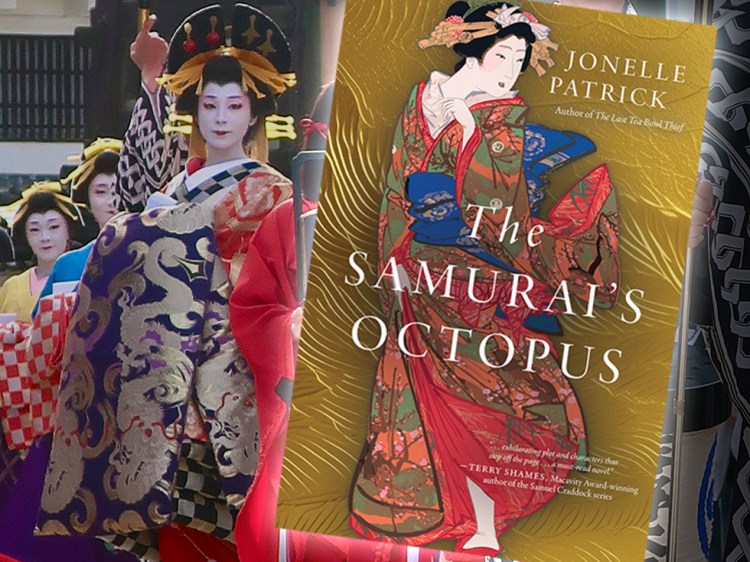
“Patrick’s ability to draw the reader into the setting is masterful. I feel as if I time traveled to 18th Century Japan. An exhilarating plot and characters that step off the page make this a must-read novel.”
—Terry Shames, Macavity Award-winning author of the Samuel Craddock series
“…complex, vibrant characters and a twisting plot that will keep you guessing—and turning pages—all the way to the end. I couldn’t put it down!”
—Susan Spann, author of the Hiro Hattori mysteries
“…complex, vibrant characters and a twisting plot that will keep you guessing—and turning pages—all the way to the end. I couldn’t put it down!”
—Susan Spann, author of the Hiro Hattori mysteries
•
If you enjoyed this, subscribe!
Get all the latest Japan travel tips and tricks for free ヽ(*^ω^*)ノ
And here are the other places I take my friends when they come to town
•
Jonelle Patrick writes novels set in Japan, produces the monthly e-magazine Japanagram, and blogs at Only In Japan and The Tokyo Guide I Wish I’d Had
 Jonelle Patrick writes about Japan